Go beyond language.
Hear what matters.
It’s well known that early intervention is critical to achieving better recovery and return-to-work outcomes for injured workers. However, could more be done at this crucial first step to improve culturally and linguistically diverse (CALD) workers’ outcomes?
Culture is more than language
Australia has one of the world’s most diverse, multicultural populations.
of Australians identified with an ancestry other than Australian as their first response*
reported having at least one parent who was born overseas*
of the population were born in another country^
of the population speak a language other than English*
*2021 Census question; ^Australian Bureau of Statistics (June 2024)
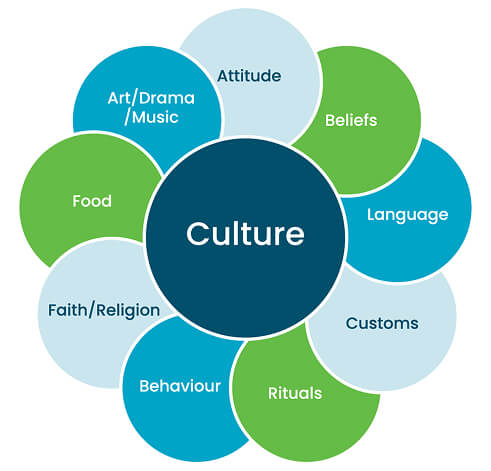
What makes up culture?
Culture is so much more than just language proficiency. Factors such as health beliefs, family dynamics, religion, trust in systems and stigma around injury or mental health can all impact a client’s recovery journey – regardless of whether they are proficient in English or not. Without recognising these factors, even early intervention can fall short.
As a result of not identifying cultural barriers early, research shows that culturally and linguistically diverse (CALD) clients often experience:
- Delayed engagement and longer claim durations
- Lower return-to-work rates when cultural factors aren’t addressed
- Increased risk of disengagement without tailored support
Diagram: Culture is defined as a transmitted system of symbols, meanings, and norms form a historical chronology (Collier & Thomas, 1988; Geertz, 1983; and Schneider, 1976)
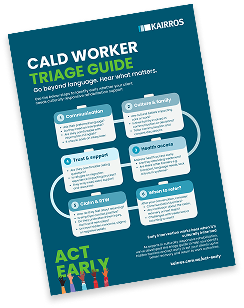
Early intervention works best when it’s culturally informed
As experts in culturally responsive rehabilitation, Kairros has developed a ‘CALD Worker Triage Guide’ to help you identify hidden barriers and ‘act early’ to set your clients up for better recovery and return-to-work outcomes.
Industry findings, including those found in Kairros’ recently published White Paper, highlight early, culturally responsive intervention improves recovery outcomes, reduces claim costs and supports sustainable return to work.
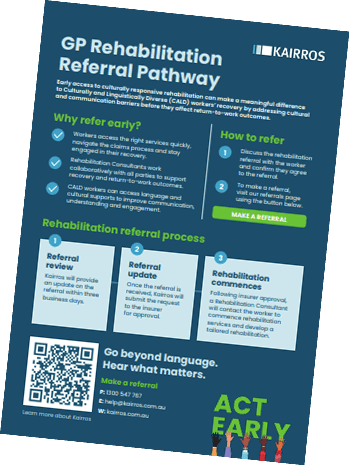
GP’s act early to help your patients
GPs play an important role in helping injured workers access the right support early in their recovery journey.
If you have concerns about a worker’s recovery, capacity for work or ability to navigate the claims process, consider referring early for workplace rehabilitation.
Our GP Rehabilitation Referral Guide provides a simple overview of:
- Why an early workplace rehabilitation referral matters
- How GPs can support recovery and return to work
- Considerations when supporting CALD workers
- How to discuss and make a workplace rehabilitation referral
Download the guide to learn more about the referral process and how Kairros can support your patient’s recovery and return to work.
Act early. Get your team involved.
For a limited period, throughout our ‘Act early’ awareness campaign, Kairros has developed a free engaging, in-person workshop.
This workshop will take your team deeper into what is culture, the importance of identifying cultural barriers early and how to effectively embed our ‘CALD Worker Triage Guide’ into your claims practice.